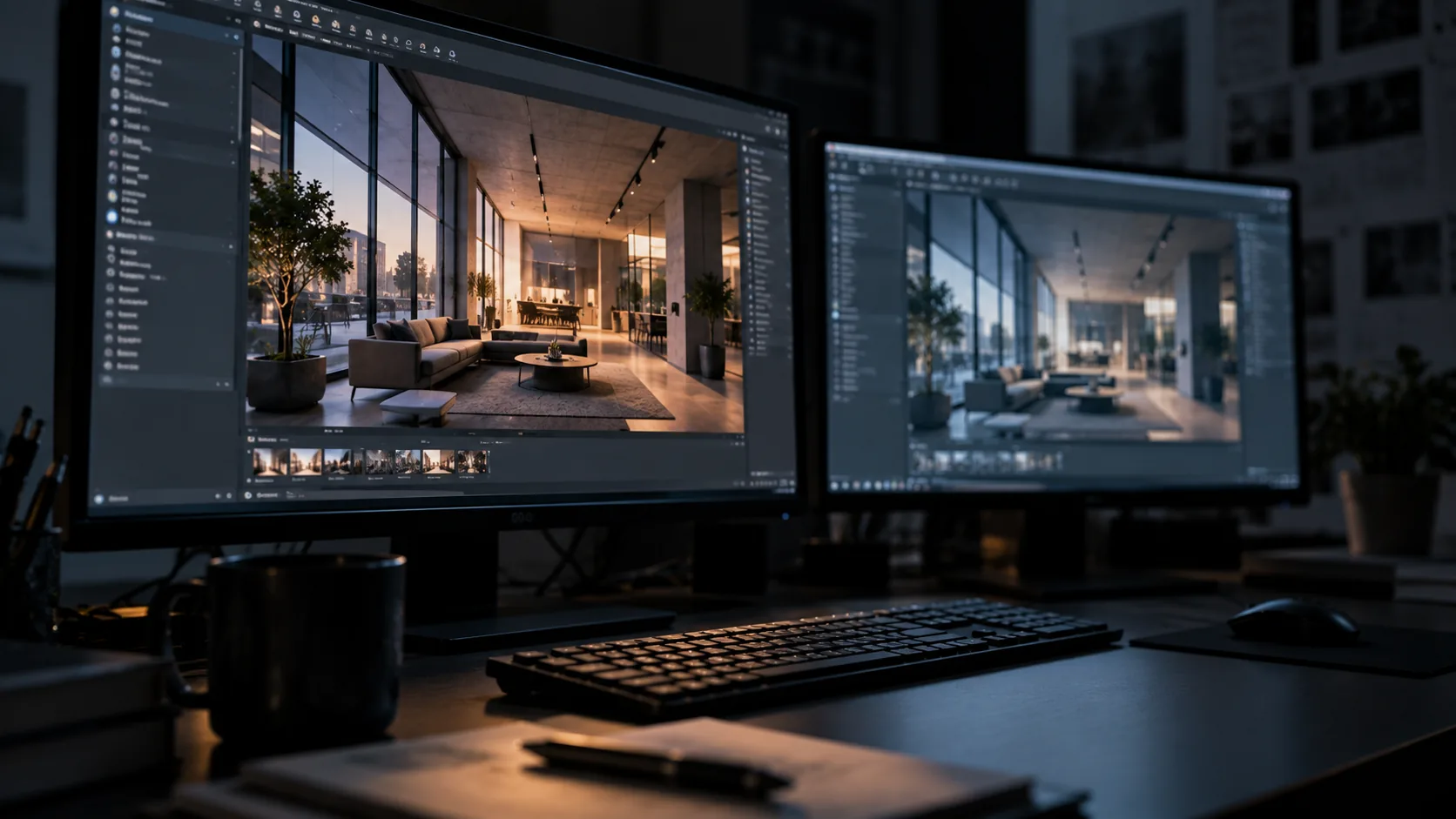
The gap between real-time and ray-traced imagery has narrowed dramatically. Real-time engines now produce still frames that many viewers cannot distinguish from offline renders, which has made the choice between them genuinely situational rather than a straightforward quality trade-off.
The question is no longer which produces better images. It is which serves the purpose.
The underlying difference
Offline rendering — the ray-traced approach used by V-Ray, Corona, Cycles, Arnold and similar engines — simulates light transport thoroughly, computing each image over minutes to hours. Accuracy is high; iteration is slow.
Real-time rendering — Unreal Engine, Unity, Twinmotion, D5, Lumion and their peers — produces frames in milliseconds using a combination of rasterization, pre-computed lighting, and increasingly capable hardware ray tracing. Interaction is immediate; the deepest lighting effects are approximated, though the approximations have become very good.
The distinction that still holds is interactivity versus per-frame fidelity, and it maps onto purpose more cleanly than onto quality.
Where real-time is decisively better
Design iteration. Changing a material, a window proportion, or a sun angle and seeing the result immediately changes how design decisions are made. With offline rendering the feedback loop is long enough that the designer moves on before the image returns.
Client and stakeholder review. A live session where the client asks to see the space with a different finish, or from a different position, and it happens in the meeting, is qualitatively different from presenting fixed images and taking notes. It also surfaces objections early, when they are cheap.
Walkthroughs and flythroughs. Animation cost in offline rendering scales with frame count, which makes long sequences expensive. In real time, the sequence is a camera path through an already-built scene.
VR and immersive review. Real-time is the only practical option. VR review is genuinely valuable for spatial judgment — ceiling heights, corridor widths, sightlines — in a way that no still image achieves.
Interactive configurators. Sales tools where a prospective buyer selects finishes, unit types, or orientations require real-time rendering by definition.
Sun and shadow studies. Immediate feedback across the year, interrogable live rather than delivered as a fixed set.
Volume work with many views. Once the scene is built, additional cameras are nearly free. For a project requiring dozens of views, this changes the economics substantially.
Where offline rendering still leads
Large-format print. High resolution for print remains offline territory, where render time per frame is irrelevant because there is one frame.
Complex lighting. Dusk scenes with many artificial sources, complex caustics, dense volumetric atmosphere, and interiors relying on multiply-bounced indirect light are still resolved more convincingly offline.
Physically accurate material response. Layered and translucent materials — brushed and anisotropic metals, patterned and coated glass, marble and stone with subsurface behaviour, fabrics with sheen — reward the full simulation.
Very high geometric density. Scenes with extremely heavy geometry may be more practical offline than optimized for real-time performance, depending on the pipeline.
Absolute fidelity at close range. Where the camera is close to a surface and every material detail is scrutinized, offline retains an edge.
The hybrid pipeline
Most capable studios now run both, which reflects how the workflows actually complement each other.
A common structure:
- Model preparation once, in a shared environment, with materials authored to a standard that both pipelines consume.
- Real-time for design development — iteration, sun studies, client reviews, VR sessions.
- Real-time for animation and interactive deliverables.
- Offline for hero stills — the small number of images that will be printed large or scrutinized closely.
- Shared asset library — vegetation, furniture, vehicles, and materials maintained for both.
The efficiency comes from preparing the model once. Maintaining two separate scene builds negates most of the benefit, so material and asset standards that work in both pipelines are worth establishing early.
Practical considerations
Hardware. Real-time rendering requires capable GPUs on every workstation that will run it and on any machine used for client presentation. Offline rendering can be distributed to a render farm or cloud service, so individual workstations matter less.
Skills. Real-time engines, particularly Unreal, carry a steeper learning curve than adding a render engine to an existing modeling workflow. Optimization — level of detail, lightmap resolution, draw calls, culling — is a genuine discipline.
File size and delivery. Interactive deliverables are large and require either a packaged executable, a cloud-streamed service, or a controlled viewing environment. This affects how clients receive them.
Longevity. A still image is permanent. An interactive deliverable depends on an engine version and hardware, and may require maintenance to remain usable in three years. For anything intended as a lasting record, stills and video are safer.
Choosing by deliverable
| Deliverable | Recommended |
|---|---|
| Design iteration | Real-time |
| Client design review | Real-time |
| VR spatial review | Real-time |
| Walkthrough video | Real-time |
| Sun and shadow study | Real-time |
| Sales configurator | Real-time |
| Marketing hero still | Offline |
| Large-format print | Offline |
| Complex dusk interior | Offline |
| Verified view for planning | Either, with accuracy documented |
| High-volume view sets | Real-time |
Planning visuals warrant a note: the engine is irrelevant to the authority, but camera accuracy, terrain accuracy, and documented methodology are not. Either pipeline can produce a compliant verified view; neither does so automatically.
Preparing a model that serves both pipelines
The efficiency of a hybrid approach depends entirely on preparing geometry once. That requires modeling and material decisions that suit both engines.
Geometry. Clean, closed, correctly oriented normals, with no coincident faces. Real-time engines are less forgiving of geometry errors than offline renderers, so preparing for real-time produces a model that works in both. Model at the density the camera will resolve and no more; excessive geometry costs performance in real time and render time offline.
UV mapping. Real-time lighting and texture behaviour depend on sensible UVs. Offline rendering tolerates worse mapping, which is why models prepared only for offline often need rework to run in real time.
Materials by a consistent standard. Physically based materials — base colour, roughness, metallic, normal — translate between engines far better than engine-specific shaders. Authoring to that standard is what makes the shared library possible.
Real-world scale. Materials and lighting both depend on correct scale. A model at the wrong unit scale produces lighting that cannot be corrected by adjustment.
Named, organised hierarchy. Objects grouped and named consistently so that material assignment, visibility toggling, and asset swapping are possible in either environment.
Level of detail variants for repeated assets, so distant instances use lighter geometry.
Deciding for a specific project
Three questions usually settle it:
How many times will this be looked at, and by whom? A single image for one presentation is an offline still. Something a sales team will use for eighteen months across many conversations is an interactive asset.
Will the design change during the deliverable's life? Real-time assets update; rendered stills are re-rendered.
What is the viewing environment? A committee room with a projector, a sales suite with dedicated hardware, a printed brochure, and a website all impose different constraints, and the deliverable should be chosen for where it will actually be seen.
Answering these before commissioning avoids the common outcome of a beautiful interactive experience that nobody has the hardware to run, or a set of stills that cannot answer the question the client keeps asking.
Frequently asked questions
Can real-time output be used for print? Increasingly yes, at moderate sizes, particularly with high-quality path-tracing modes now available in real-time engines. For very large formats and the most demanding lighting, offline remains the safer choice.
Is it worth building an in-house real-time capability? For firms producing visualization regularly, yes — the iteration benefit alone justifies it. For occasional needs, engaging a studio is more economical than maintaining the skills and hardware.
Does the client need special software to view interactive deliverables? Usually a packaged application or a streamed link. Confirm the client's IT constraints before committing to an interactive deliverable, since some corporate environments will not run one.
Related reading: What Actually Drives the Cost of Architectural Rendering · Virtual Staging and Interior Visualization for Developers · Visuals for Planning Applications: Accuracy Over Atmosphere
Vantage CAD Services produces both real-time and ray-traced visualization from a shared model preparation pipeline. Contact info@vantagecadservices.com or +1 (512) 543-0831.